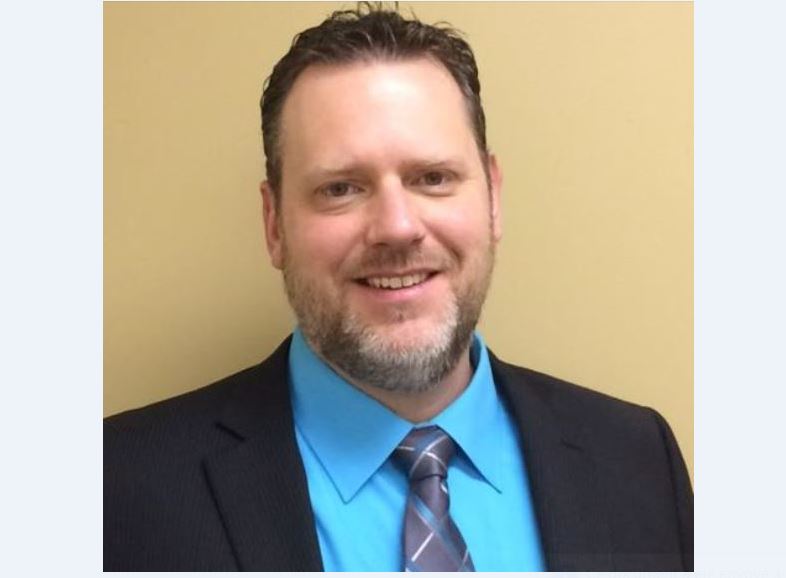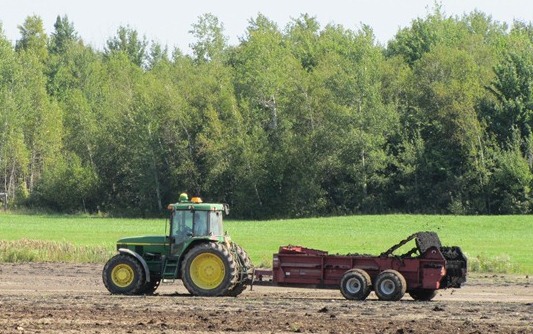
In Huntingdon, on Wednesday, agronomist Marc Hébert gave a talk about the myths and realities of spreading fertilizing residuals (FR) or industrial biosolids which include sewage sludge. Although its practice is regulated, its use remains controversial.
The meeting, organized by the Club agroenvironnemental du bassin Laguerre attracted a good sized crowd to hear the specialist from the Ministry of the Environment. Hébert stated that he knew there were people present who were not in favour of this practice and that it was therefore his role to provide information.
« In the Montérégie, 4.7 % of agricultural land receives fertilizing residuals, » indicated the man responsible for quality standards of compost, biosolids, digestate and other FR for the Ministry. FR will not change agriculture, but they can make a difference. »
He made a distinction between the different types of FR, but concentrated mostly on sewage sludge. The plant in Valleyfield is one of the plants in Québec that offers this sludge as a fertilizer.
Being only 90% sterilized, means that it cannot be spread on land growing crops for human consumption. Other criteria such as even a small amount of odour, chemical contaminants or other foreign bodies add restrictions concerning its storage and use.
In spite of concerns, this practice has existed for 30 years in Québec. « FR are not toxic if they are used according to guidelines, » argued Hébert. « They increase fertilization in the soil. »
He revealed that in one year, The Centre for Poison Control received 2700 calls connected to pesticide use. Biosolids used on agricultural land at agronomic rate do not represent any cases of eco-toxicity.
In the Montérégie, 70 farms that spread sewage sludge have been inspected on 27 control points. They attained a 99% rate of compliance.
In spite of these numbers, doubt persists. « In general, sludge is a taboo subject in society, » explained Hébert. « For that reason alone, the file will always be difficult. Social acceptability cannot be ignored. »
Members of the group Citoyens du Haut-Saint-Laurent pour la gestion responsable des boues came to the meeting. They refute Hébert’s claims and studies which date from 2011.
A document on the concentration of heavy metals in fertilizers, containing numbers from the Institut national de santé publique du Québec, were handed out at the exit to the conference room. The figures differ between hog manure, cow manure and municipal sewage sludge. « Spreading FR has nothing to do with traditional fertilizers. Our fields become the dumping ground for cities that don’t know what to do with their polluted sludge. Protect our water and our soil. Say no to this shit. » says the flyer.
France Lemieux, a member of this group, did not attend the conference. But the Godmanchester resident confirmed that she and Hébert do not agree on this issue.
A resident of the Haut-Saint-Laurent since 2009, Lemieux calls herself an « old environmentalist from the 60s », and admits that two promoters store and spread FR in the area. « One of them is my neighbour. The spreading is 100 m from my well, but 10 m from my land, » said Lemieux. « The first time, it was the odour that I noticed. But it’s not just odour. I have been studying what’s in it [sewage sludge] since 2011. There is nothing reassuring about it. »